
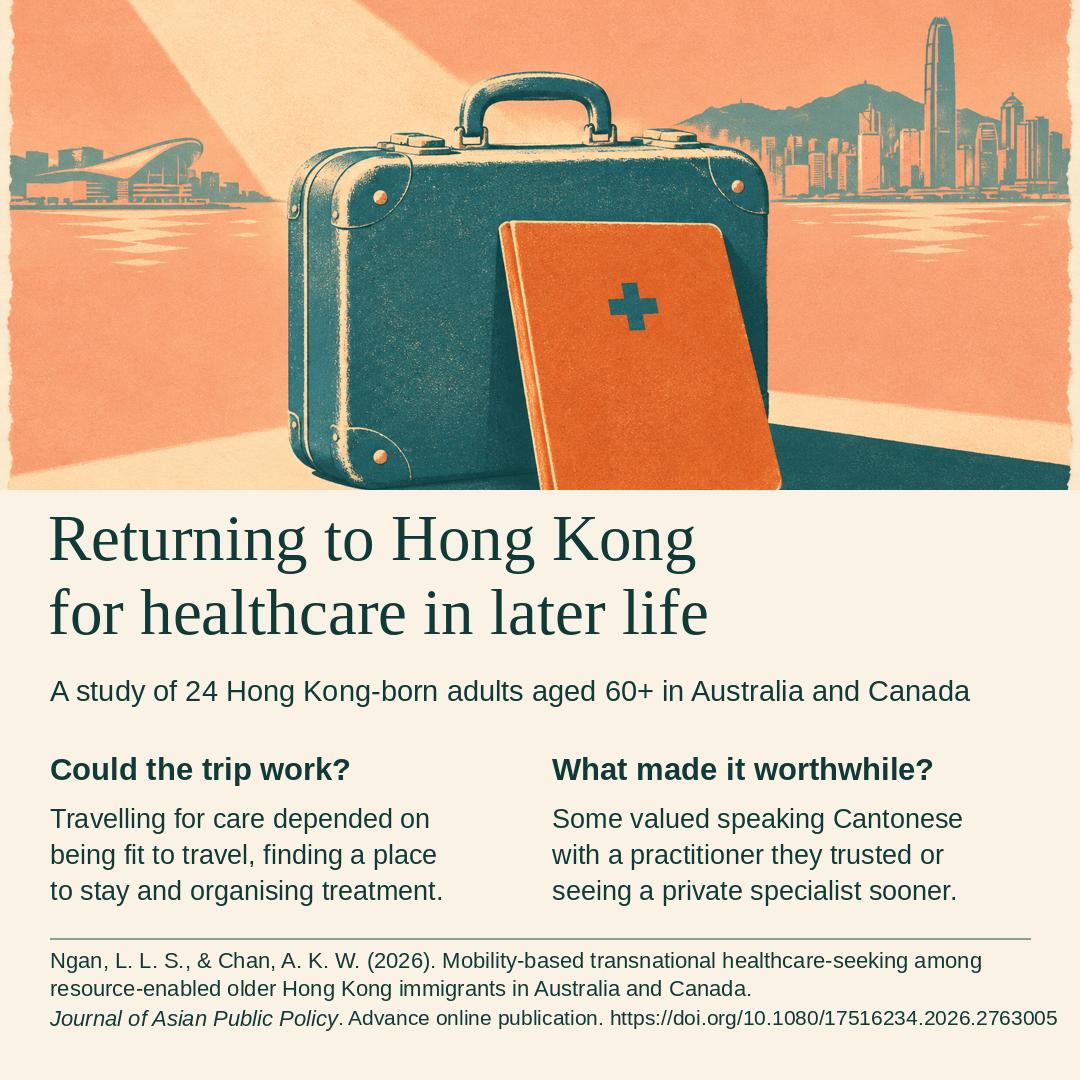
What makes it possible to return to Hong Kong for healthcare in later life?
Ngan and Chan (2026) interviewed 24 Hong Kong-born adults aged 60 or over living in Australia and Canada. Before they could weigh up where to see a doctor, they had to consider whether they could make the journey, find somewhere to stay and keep their treatment on track across two healthcare systems.
When travel was feasible, some valued the chance to describe symptoms in Cantonese, consult a trusted Chinese medicine practitioner or see a private specialist sooner. Friends and family helped people find practitioners. Some participants used Hong Kong’s healthcare vouchers to reduce costs on visits they had already planned.
Four of the 24 did not seek care in Hong Kong. The demands of travel and the difficulty of coordinating treatment could put that option out of reach. Most participants were women, and many could afford regular travel. The findings therefore tell us most about older migrants with the resources to consider a return trip.
The authors suggest improving access to professional interpreters in Australia and Canada and making it easier for patients to carry a medical summary between providers.
Source
Ngan, L. L. S., & Chan, A. K. W. (2026). Mobility-based transnational healthcare-seeking among resource-enabled older Hong Kong immigrants in Australia and Canada. Journal of Asian Public Policy. Advance online publication. https://doi.org/10.1080/17516234.2026.2763005
──────────
How can healthcare systems better serve ageing communities? HSUHK’s Department of Social Science explores that question through electives on ageing societies and healthcare systems in the Master of Social Sciences in Social Sustainability. Learn more at https://programme.hsu.edu.hk/en/ss