
Project Overview: Strengthening Support for Youth Micro-Ein Hong Kong
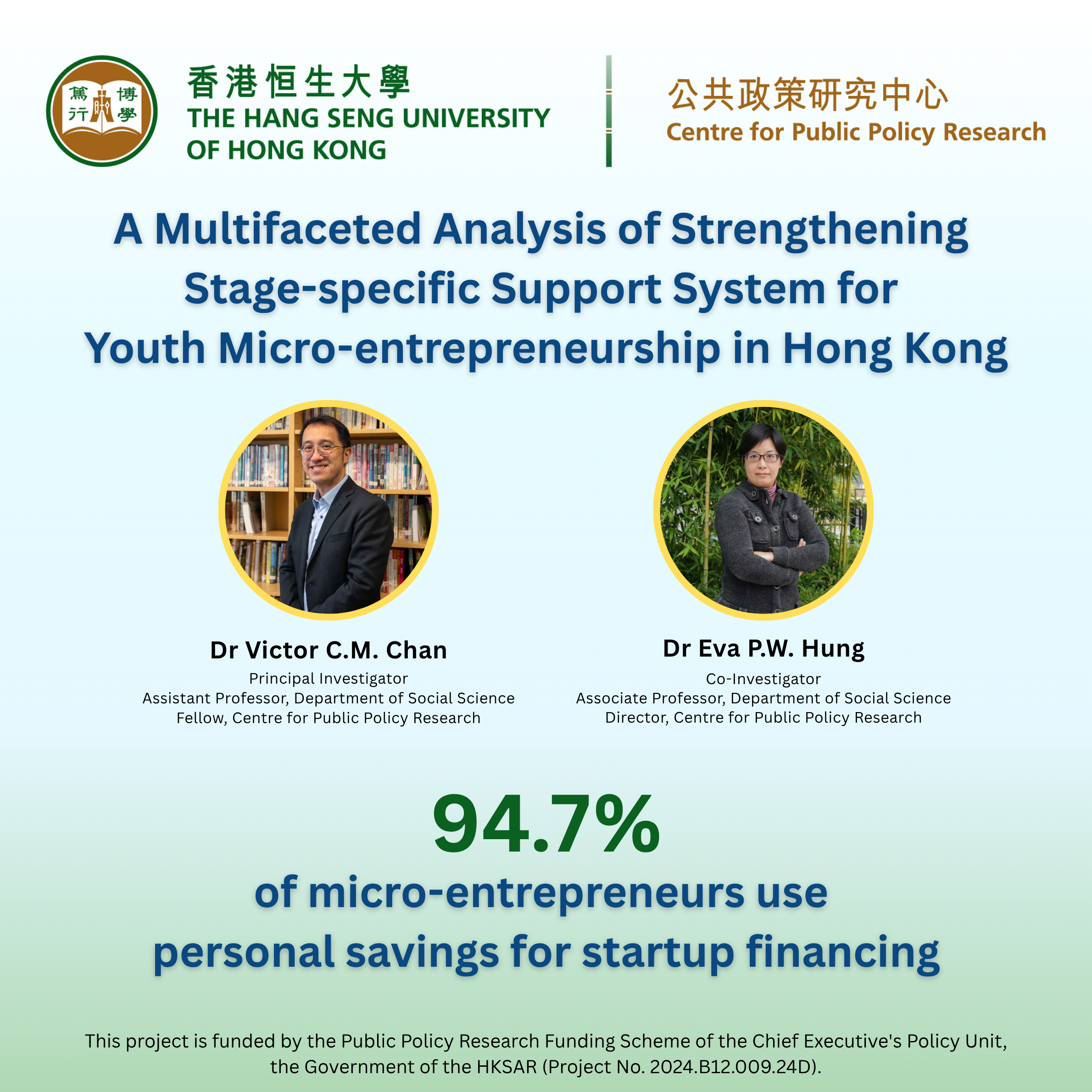
The research project, titled “A Multifaceted Analysis of Strengthening Stage-Specific Support System for Youth Micro-Entrepreneurship in Hong Kong,” investigates the unique challenges and support requirements of young micro-entrepreneurs (aged 18–35) operating businesses with fewer than 10 employees. Led by Dr Victor Chan Chi-ming (Principal Investigator) alongside Dr Eva Hung Po-wah and Dr Thomas Man Wing-yan (Co-Investigators), the study is funded by the Public Policy Research Funding Scheme of the HKSAR Government.*
While youth micro-entrepreneurs are essential drivers of innovation and social mobility in Hong Kong, they often operate in an ecosystem that prioritizes high-growth technology startups, leaving many non-tech ventures in retail, creative industries, and professional services under-supported.
Research Methodology
The study employed a rigorous multi-method approach, beginning with a comparative policy analysis of entrepreneurial frameworks in London, Beijing, and Hong Kong. This was followed by empirical data collection involving 25 entrepreneur interviews, 20 stakeholder interviews, and a comprehensive online survey of 627 youth micro-entrepreneurs.
Key Research Findings
- Persistence of Capital Constraints and Stage-Specific Challenges: Access to capital remains the most significant barrier throughout the business lifecycle, though its intensity fluctuates from the start-up phase (68.7%) to future development (45%). Challenges are highly stage-specific: the Existence stage is defined by registration and startup costs, while the Survival and Success stages are dominated by concerns over cash flow, rent, and work-life balance.
- Dominance of Informal Support Networks: The findings reveal a heavy reliance on informal support (46.9%) compared to formal institutional aid (18.2%). Start-up financing is predominantly internal, with 94.7% of respondents using personal savings and 62.7% receiving family contributions. Scheme-based entrepreneurs rely more on institutional legitimacy, grants, and incubators, whereas self-initiated entrepreneurs rely more on former employers, personal reputation, and industry contacts.
- Non-Linear Growth and Diverse Definitions of Success: Growth trajectories are frequently non-linear, involving pivots, interruptions, or periods of stagnation. Furthermore, young entrepreneurs define success through multiple lenses: while 39% prioritize business expansion, significant portions of the cohort value stable income (28.6%) and work-life balance (20.8%) over rapid scaling.
- Institutional Bias Toward Technology Sectors: There is a widely perceived “tech bias” in current policy frameworks, with many non-tech entrepreneurs feeling excluded from funding, incubation, and mentorship opportunities geared toward AI or deep-tech ventures.
- Strategic Hesitation Regarding GBA Expansion: Although the Greater Bay Area (GBA) represents a significant opportunity, 66.2% of respondents expressed “strategic hesitation”. The primary barriers to entry include high costs (57.9%), limited market knowledge (56.5%), and regulatory differences (48.3%).
- AI as a Tool for Resilience: Artificial Intelligence is increasingly integrated as an “invisible colleague,” with 60.3% of users reporting improved efficiency. While AI supports administrative tasks and emotional resilience, entrepreneurs emphasize that it cannot replace human judgment or authentic interpersonal relationships.
Policy Recommendations
The project recommends a stage-specific support framework, stronger coordination between formal and informal support, better non-tech support pathways, practical GBA guidance, balanced AI integration, stronger entrepreneurship education, and broader success indicators.
- Developing stage-specific support schemes that address specific needs from registration to maturity.
- Coordinating formal and informal support that integrates advisor, officer, and peer support.
- Closing support gaps for non-tech sectors through dedicated funding and sector-specific mentorship.
- Providing practical GBA pathways through city-specific guidance, trusted network matching, and enhanced collaboration among local governments.
- Building a balanced AI approach by offering practical AI training, ethics/privacy guidance, AI-enabled routine support, continued human advising.
- Broadening success indicators in policy evaluations to include survival, autonomy, resilience, work-life balance, and social contribution.
- Reforming entrepreneurship education to nurture a resilient mindset in secondary and higher education.
——————————————————————————–
*Acknowledgement: This research project (Project Number: 2024.B12.009.24D) is funded by the Public Policy Research Funding Scheme of the Chief Executive’s Policy Unit, The Government of the Hong Kong Special Administrative Region (project in progress)